
1967 Kennedy Half Dollar SMS vs Circulation Strike: What’s the Difference?
Silver was already disappearing from American coins by the late 1960s. The Kennedy half dollar still contained 40% silver in 1967, but production rules had changed, and mint marks were removed. Many collectors ask a simple question: what really drives the 1967 Kennedy half dollar value?
The answer is more complex than the silver content or the date. In 1967, two types were struck: regular circulation pieces and Special Mint Set (SMS) coins. They look similar, but the market treats them differently. So, let’s check what explains the price gap.
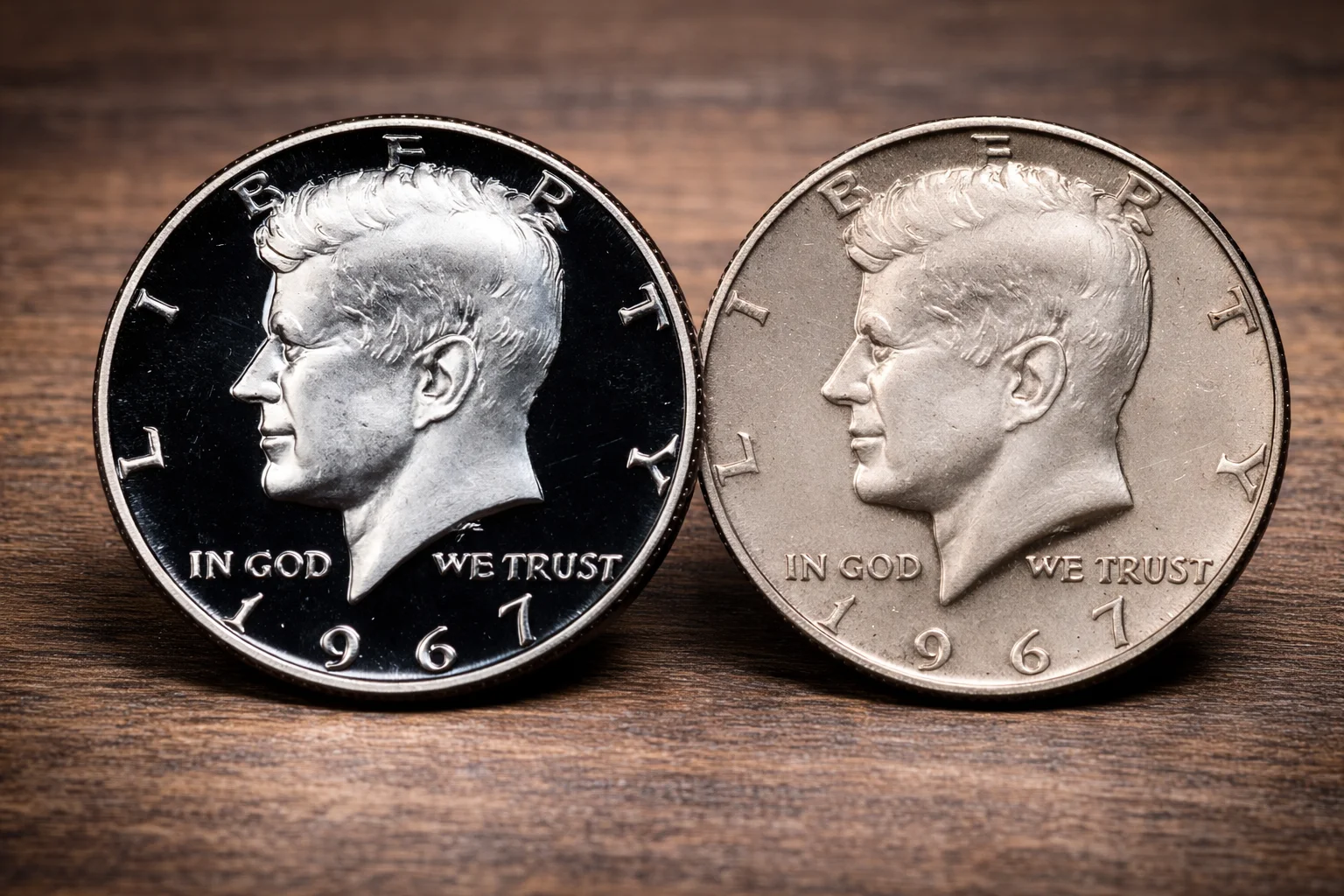
Main Specifications
Before comparing finishes, we invite you to confirm the fundamentals.
Feature | Detail |
Year | 1967 |
Mint Mark | None (mint marks suspended) |
Composition | 40% silver clad |
Weight | 11.50 g |
Diameter | 30.6 mm |
Edge | Reeded |
Types | Circulation & SMS |
All 1967 Kennedy half dollars were struck without mint marks. This was Mint policy from 1965 through 1967. Absence of a letter does not signal rarity.
The composition matters. These coins contain 40% silver. The outer layers are silver alloy bonded to a copper core. That silver content gives every 1967 half a built-in melt floor. Even worn examples carry intrinsic metal value.
However, a collector's premium depends on more than metal.
What Was Happening in 1967?
Silver shortages shaped production decisions. After the 1964 90% silver halves vanished from circulation, the Mint reduced silver content to 40%. The goal was to keep the denomination alive while lowering intrinsic value.
Proof sets were also suspended during these years. Instead of traditional proofs, the Mint issued Special Mint Sets. These sets contained coins struck with more care than circulation pieces but not polished to proof standards.
This decision created two categories for the same date:
Regular business strikes intended for commerce
Special Mint Set coins are intended for collectors
That distinction defines the market today.
Circulation Strike: The Standard Issue
Most 1967 halves were produced for daily use. They entered commerce and saw handling. These coins show the characteristics typical of high-volume production.
Strike quality varies. Details on Kennedy’s hair can appear soft. The eagle’s feathers may lack full separation. Surfaces often show contact marks from bags and transport.
Even uncirculated examples from rolls tend to display abrasions. These are not defects. They reflect mass production and storage conditions.
In circulated grades, wear appears on predictable areas:
Kennedy’s cheek
Hair above the ear
Jawline
Eagle’s breast feathers
Luster fades quickly once the coin enters use. High points smooth first. The result is a duller, flatter look.
Most surviving 1967 halves fall into this category.
SMS Strike: A Different Finish
Special Mint Set pieces are not proofs. They were struck with greater care than business strikes but without the deep mirror fields of proofs.
SMS coins usually show:
Sharper detail in hair and lettering
Cleaner fields
Fewer contact marks
A smoother, more refined surface texture
Edges may appear slightly more defined. The overall eye appeal tends to be higher.
Unlike proofs, SMS coins were not individually handled in the same way. They were packaged in cellophane and sold directly in Mint sets.
The difference is subtle but visible once you compare examples side by side.
Side-by-Side Comparison
Feature | Circulation Strike | SMS Strike |
Surface Texture | Standard luster | Smoother, satin-like |
Contact Marks | Common | Minimal |
Detail Sharpness | Variable | Generally stronger |
Field Finish | Less refined | Cleaner appearance |
Packaging | Released for use | Sold in Special Mint Sets |
The difference is not dramatic like proof versus circulation. It is more nuanced. Surface quality is the main separator.
Value: Where the Gap Appears
Silver content creates a baseline. Even heavily worn examples trade near melt value.
However, the market separates coins by grade and strike type.
Circulation strikes:
Circulated: melt value range
MS60–MS63: modest premium above melt
MS65: moderate collector interest
MS67: scarce and significantly higher
SMS strikes:
Typical SMS65–67: stronger demand than business strikes
SMS68: rare and valuable
This is where grading becomes critical.
Many collectors rely on the best coin value app to check market ranges before buying or selling. Digital tools help estimate bullion value and compare recent sales. Still, the grade must be accurate. A single grade point can double the price at higher levels.
Why Grade Outweighs Type
Strike type matters. Grade matters more.
A low-grade SMS coin may trade close to melt. A high-grade circulation strike can outperform lower SMS examples.
Surface preservation determines price. On silver-clad coins, hairlines and small abrasions stand out under light. Luster breaks reduce appeal.
When verifying details such as composition or confirming the year, a coin scanner app can assist. Coin ID Scanner helps confirm technical data and store pieces in a digital collection. It supports organization and identification. Final grading still depends on careful visual inspection.
In upper Mint State levels, surface quality is everything.
Melt Value vs Collector Premium
The 40% silver composition sets a floor. Metal value fluctuates with bullion prices. This prevents the coin from falling below its intrinsic value.
The collector premium begins where:
Grade improves
Eye appeal strengthens
Scarcity in high condition appears
The largest premiums occur in:
MS67 circulation strikes
SMS68 and above
Most 1967 halves remain common in lower Mint State grades. Exceptional preservation drives price.

Known Errors and Varieties
Although not a rare date, the 1967 Kennedy half dollar does show legitimate mint errors.
Recognized examples include:
Doubled Die Obverse: visible doubling on LIBERTY or the date
Doubled Die Reverse: doubling in eagle details
Missing Clad Layer: copper-colored surface where the silver layer failed
Off-Center Strikes: misaligned design with blank crescent
Struck on Wrong Planchet: rare but significant
Clips and Cuds: metal missing from the edge or raised blobs
Clad layer errors are particularly noticeable because the copper core becomes visible. Strong examples command attention.
Off-center pieces increase in value as the misalignment grows, provided the date remains visible.
Doubled dies must show clear separation. Machine doubling does not qualify.
Surface damage does not count as a mint error. True errors originate during production.
How to Identify SMS vs Circulation in Practice
Examine under strong light.
Tilt the coin slowly.
Look for:
Uniform satin texture
Fewer bag marks
Crisp lettering
Compare with a known circulation example if possible. The difference becomes clearer side by side. If uncertain, rely on professional grading for higher-end candidates.
Market Behavior Over Time
Interest in 1967 halves often rises with silver prices. Bullion fluctuations affect base demand.
Collector demand focuses on top grades. Registry competition increases premiums for MS67 and SMS68 pieces.
Common grades remain stable. High-end pieces experience sharper movement.
This pattern explains why two coins of the same date can trade in dramatically different ranges.
Final Assessment
The 1967 Kennedy half dollar stands at an interesting point in U.S. coinage history. Silver content provides a foundation. Market behavior depends on grade and strike type, not simply the year.
Circulation strikes remain common in lower grades. SMS coins offer better surface quality and stronger appeal in high grades.
Understanding this distinction prevents pricing mistakes. It also explains why some examples trade near melt while others reach substantial premiums. Thus, the year 1967 teaches a simple lesson: the surface tells the story.
Novità
-

Book Review: The Silent Patient by Alex Michaelides
In the world of literature, there are always a few books that manage to capture the attention of readers around the globe. One such recent bestseller that has been making waves in the literary communi...
Read more Read more -

From Dickens to Data: How Location Tracking Apps Could Have Changed Classic Literary Plots
Explore the fascinating impact of modern technology on classic literature. Imagine how GPS and location tracking apps would have altered the plots of beloved stories by Doyle, and Austen, transforming...
Read more Read more -

Top 10 Must-Read Books of the Year: Expert Reviews and Recommendations
Discover the top 10 must-read books of the year with expert reviews and recommendations on Book Quest. Explore diverse genres and themes, from philosophical journeys and historical analyses to magical...
Read more Read more -

Big Brother Is Watching You: Literary Works on Stalking & Surveillance
Explore the themes of stalking and surveillance in literature, reflecting modern anxieties about privacy, control, and technology. Discover how these narratives examine the balance between freedom and...
Read more Read more